
How might live action role-playing become part of everyday educational practice? On 27 October, 50 educators representing 12 schools across the Municipality of Ulricehamn, Sweden, explored this question through a workshop combining practical participation, discussion and larp design.
Commissioned by the municipality, Karin Johansson from Uppsala University and Larpocracy and Gunnar Söderberg from Förbättringsverket planned and facilitated the workshop. It ran twice, with separate groups attending four-hour morning and afternoon sessions.
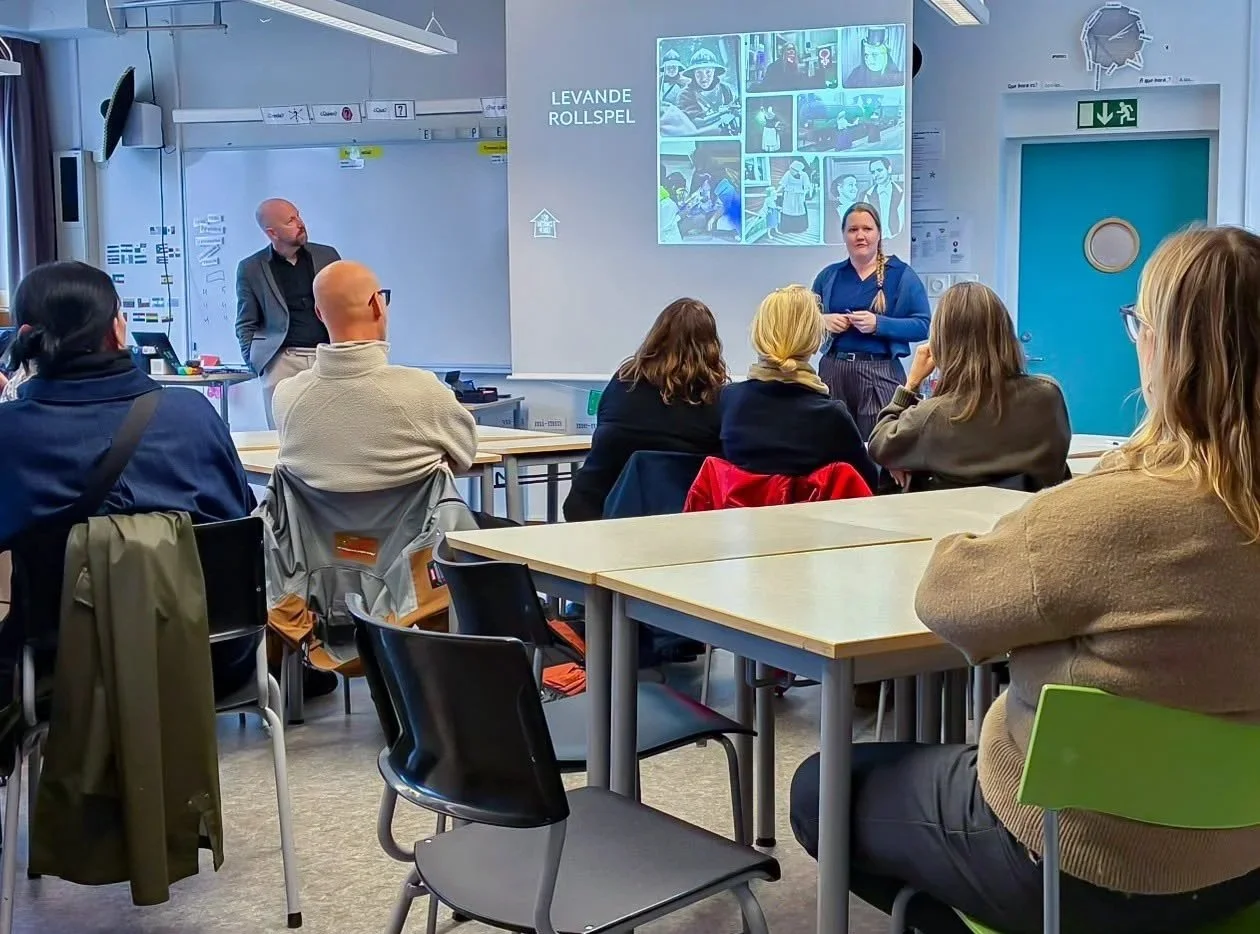
The participants worked in after-school centres across all the municipality’s schools, including a compulsory school for pupils with intellectual disabilities. The overarching purpose was to introduce educational larp and inspire educators to explore its use within their own professional settings.
Participants began with short role-play exercises and an introduction to larp and larp design. The programme then connected these methods with after-school education, including a presentation about Larpocracy and an opportunity to experience Deliberative Speed-Dating. This brought a project-developed activity into a professional learning setting, offering educators a practical starting point for considering larp’s relationship with democratic deliberation.
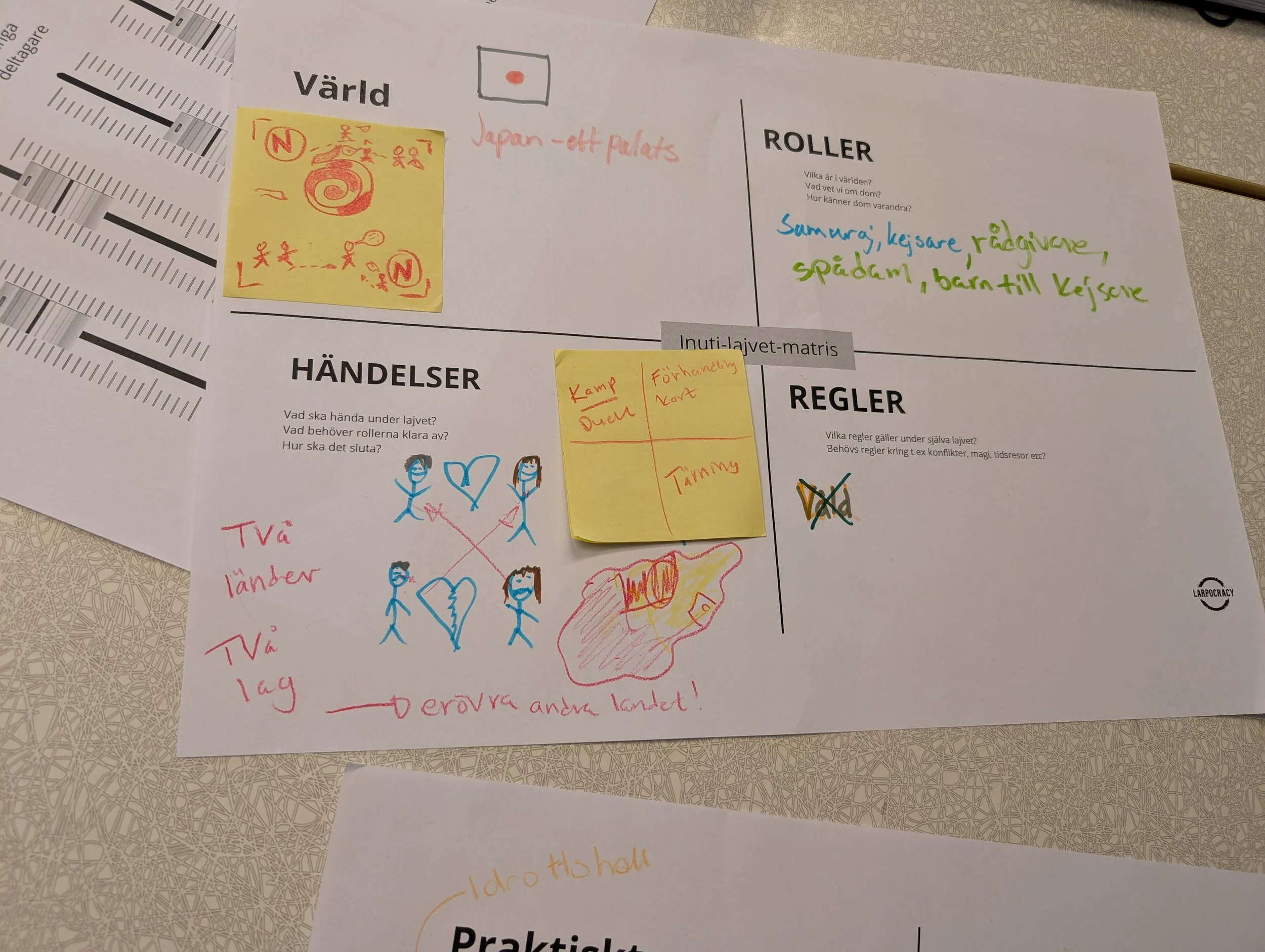
Alongside these activities, the workshop addressed safety, group dynamics and leadership. These considerations informed preparation for the final design exercise, in which participants worked in groups to develop their own larp proposals using Larpocracy’s design matrices. Printed role materials, coloured pens, sticky notes, costume items and props were available to support the activities. Groups subsequently presented and discussed their ideas.
The workshop also briefly introduced possible uses of AI, which some participants explored during the design exercise.
Swedish after-school centres, known as fritidshem, offer a particularly relevant context for this work. Their curriculum emphasises learning through play, experience and collaboration, alongside opportunities for children to participate, exercise influence and develop familiarity with democratic processes. These priorities suggest a productive connection with educational larp and Larpocracy’s research interests.
For Larpocracy, the workshop provided an opportunity to try project exercises with after-school educators and contribute to ongoing data gathering. Participants were informed about the research dimension and consented to their involvement. A municipal communicator also attended part of the workshop, with participants’ consent to photography.
The encounter opens possibilities for future follow-up on how educators might adapt these approaches within their centres. Such follow-up could help explore the transition from experiencing and designing a larp during professional development to using it in everyday educational practice.
We thank Ulricehamn Municipality, Gunnar Söderberg and all participating educators for their contributions.