

Larpocracy at British DiGRA 2026: Exploring Democracy Through the “Golden Moments” of Larp
On 1 July 2026, Larpocracy researchers Weronika Szatkowska and Sarah Lynne Bowman from Uppsala University presented emerging research from the project at British DiGRA 2026 in Wales. Their presentation shared preliminary findings from an ongoing analysis of democracy-themed live-action role-playing games (larps), asking what players remember most strongly from these experiences and what these moments might tell us about democracy as something we actively practise.
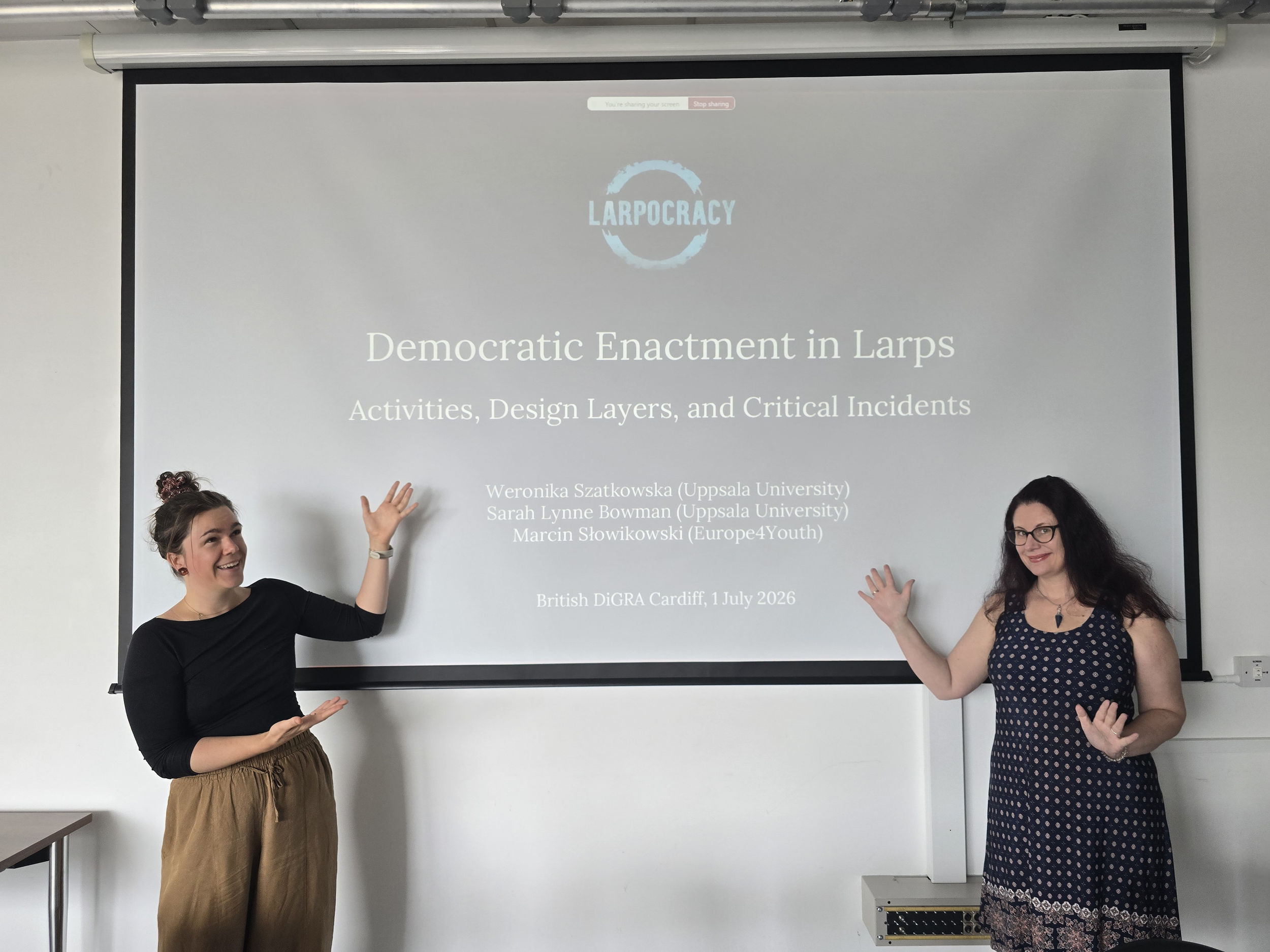
The research focuses on what the team calls “golden moments”: memorable moments that players identify when reflecting on their participation in a larp. The paper also includes data analysis by Karin Johansson from Uppsala University and Marcin Słowikowski from Europe4Youth.
By examining hundreds of excerpts from participant accounts, the researchers are working towards a broader understanding of democratic participation—one that extends beyond formal mechanisms such as elections and voting to consider the many activities through which democracy is enacted, negotiated and sustained.
What Does Democracy Look Like in Action?
The preliminary analysis has identified a wide range of activities appearing in players’ memorable experiences. These include:
Creation and design
Organising
Collaboration
Learning
Communication
Protest and resistance
Decision-making
Experimentation and reflection
Sharing
Listening and empathy
Numerous subcategories are also emerging as the analysis progresses. Some findings have been unexpected. For example, participants identified activities such as making music together as significant moments within their experiences.
Such examples point towards a conception of democracy that encompasses more than explicitly political acts. Democracy can also emerge through collective problem-solving, communication, creativity, negotiation, listening and community-building.
The emphasis on activity is particularly important. The terms “activity,” “active engagement” and “activism” all foreground doing. Democratic participation can therefore include highly visible actions such as protest and organising, but it can equally involve developing the capacity to listen carefully, understand the needs of others, negotiate disagreements or work collectively towards a shared objective.
Larp as a Space for Practising Democracy
These findings have important implications for the educational potential of larp.
For designers and educators, the emerging categories could form part of a democracy design toolbox: a set of activities that can inform learning objectives when developing experiences intended to foster democratic skills, awareness and participation.
Larp provides participants with opportunities to experiment with social and political situations while encountering consequences within the comparatively contained environment of play. Participants can make decisions, collaborate, disagree, fail, reconsider their actions and explore alternative approaches.
Questions of risk have consequently emerged from the data. How much is someone willing to risk in defence of democratic values? Within a larp, participants may be able to explore such questions with fewer real-world consequences. Outside the fictional frame, however, these decisions can carry substantial personal and political stakes.
The data also reveals the potential significance of anti-democratic experiences. Some players described moments of oppression—or situations in which they themselves participated in oppressing others—as particularly powerful. These encounters could stimulate empathy and reflection on what is at stake when democratic structures are weakened, absent or actively dismantled.
At the same time, the researchers emphasise the importance of moving beyond simulations of oppression alone. Democracy-oriented larp can intentionally create opportunities for participants to practise prosocial democratic skills, including cooperation, listening, deliberation and collective decision-making, even when the fictional setting itself is dystopian or repressive.
What Happens After the Larp Ends?
One of the most significant questions emerging from the research concerns what happens when participants return to everyday life.
Several participants reported that activities experienced through larp had influenced their own activism or professional practices. These accounts emerged from people living both in relatively stable democracies and in contexts where democratic structures have significantly deteriorated.
This raises an important question for Larpocracy: Can experiences within larp meaningfully influence democratic behaviour beyond the game?
The question connects to the broader challenge of learning transfer within educational interventions. Participants may have intensely memorable experiences and practise activities relevant to democratic participation, but this does not automatically mean those experiences will influence their subsequent behaviour, relationships or communities.
Future stages of the research will therefore examine the role of debriefing and reflection, including verbal and embodied forms of reflection, alongside the lessons participants identify and the practices through which they integrate these experiences into their everyday lives.
Understanding this movement from experience to reflection and, potentially, to action is central to evaluating how larp might contribute to democratic education and civic engagement.
Research Through Collaboration
The research presented at British DiGRA is itself the result of collaboration across the Larpocracy consortium.
Alongside Weronika Szatkowska, Sarah Lynne Bowman, Karin Johansson and Marcin Słowikowski, the work was made possible through data gathering and preparation undertaken by Barbara Mos and Piotr Warzyszyński from Europe4Youth and Kjell Hedgard Hugaas from LARPifiers.
Their collective work reflects one of the ideas emerging from the research itself: democracy depends upon multiple forms of participation, cooperation and shared labour.
The analysis of the hundreds of collected excerpts is still ongoing, and further findings and subcategories will be presented in future work.
For now, these preliminary results offer an important proposition: democracy is not simply something we have or something we vote for. It is also something we do.
Through collaboration, communication, listening, experimentation, resistance, reflection and collective creation, larp can provide a space in which some of these democratic practices become tangible—and where participants can begin to consider how they might carry them beyond the game and into everyday life.