

What Happens After the Larp Ends? New Research on Participation, Organisation and Democratic Skills
What remains after the costumes are removed, the fictional world is left behind, and participants return to everyday life? Can organising and participating in live-action role-playing games contribute to democratic skills, political engagement, empathy, or confidence in collective decision-making?
A new Larpocracy report, Long-Term Effects of Larp Organisation and Participation, examines these questions through one of the project’s most extensive bodies of research to date. Written by Sarah Lynne Bowman and Weronika Szatkowska of Uppsala University, the report brings together the main studies conducted within Work Package 2, which investigates the effects of larp-based interventions.
A multi-method investigation
The report approaches the relationship between larp and democracy through several complementary methods. These include a review of political and democracy-themed larps, analysis of 111 larp-related projects funded by the European Union’s Erasmus+ programme, nine workshops with designers, educators, artists and researchers, a quantitative survey, and interviews with experienced players, organisers and designers.
After data cleaning, the survey included 456 respondents, 314 of whom completed all sections of the questionnaire. It examined their larp experience, political participation, democratic values, empathy and capacity for perspective-taking. The qualitative research also incorporated 22 accounts connected to five larps featuring deliberative elements: The Association for the Advancement of Rights for Fairytale Creatures, Empire, Suffragette!, Odysseus and Eclipse.
Together, these studies offer a rich picture of how political themes are designed and experienced across different larp traditions, scales, genres and national contexts.
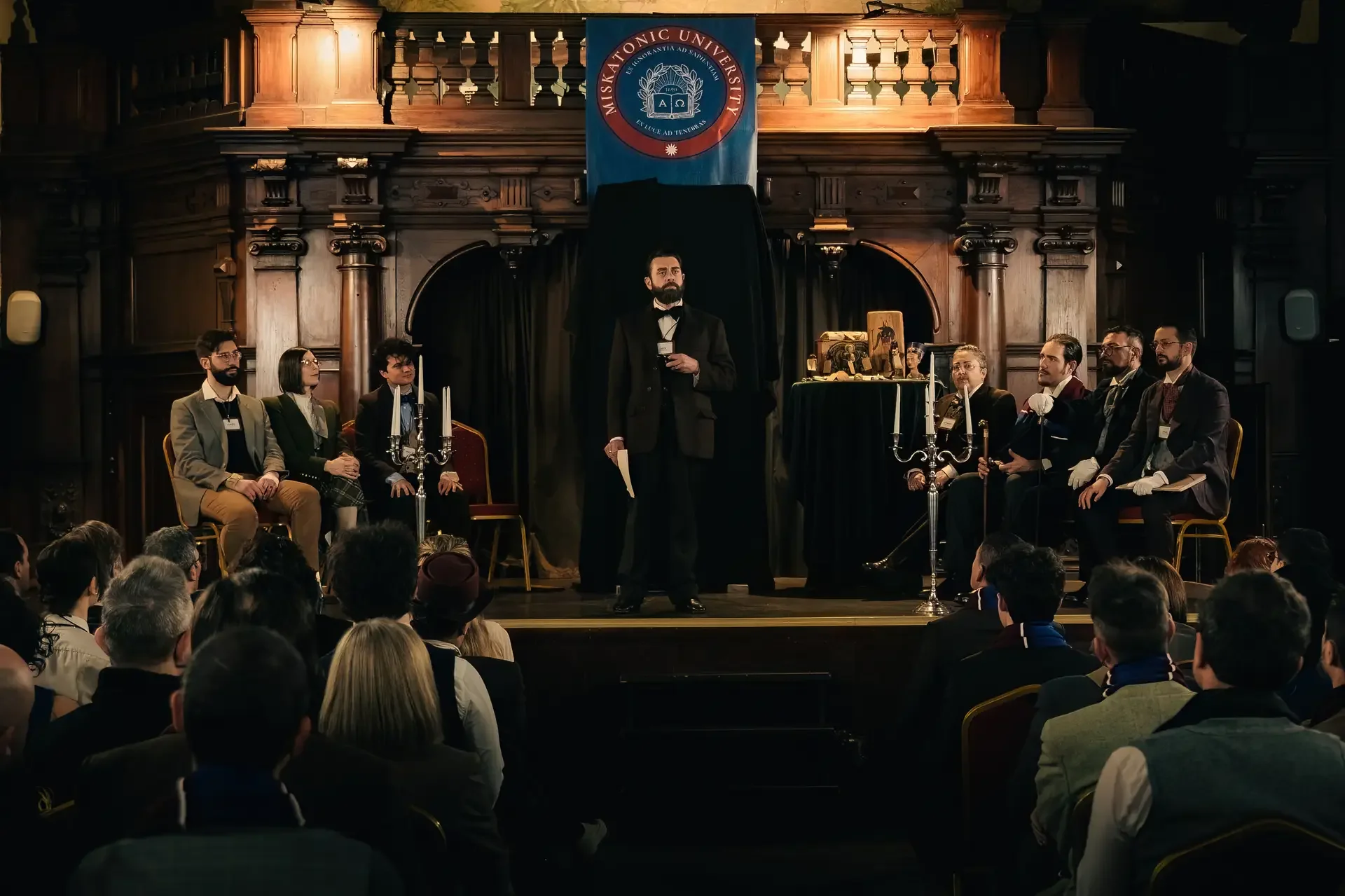
ⓒ Chaos League: Miskatonic University
Who participates in political larp?
The survey presents a sample of highly experienced and politically engaged larpers. Nearly three-quarters reported having participated in at least one larp they understood as connected to democracy. Respondents frequently occupied several roles within their communities, moving between playing, facilitating, organising, designing and researching.
The findings suggest that participation is often the foundation for deeper involvement. Almost all organisers and designers in the sample were also players, while researchers were frequently involved in organising and facilitating. Rather than being clearly separated, creative, organisational and research practices appear closely interconnected within these communities.
Respondents also reported high levels of political participation, particularly voting and discussing political issues. However, the researchers emphasise that the sample was primarily recruited through progressive national and international larp networks. It should therefore not be interpreted as representative of all larpers.
These findings will inform the next stages of Larpocracy, including the development of new deliberative larp experiments and the project’s evidence-based Democracy by Design Toolkit and policy recommendations.
By examining not only what political larps represent, but what participants actually do within them, the report offers a more expansive understanding of larp as a space for practising collective life. Its central question is therefore not simply whether larp can teach democracy, but how carefully designed experiences might allow people to rehearse listening, organising, negotiating difference and acting together.
We invite researchers, larp designers, organisers, educators and everyone interested in democratic participation to explore the full report. Long-Term Effects of Larp Organisation and Participation offers detailed findings, case studies and emerging frameworks for understanding how larp can create opportunities to practise empathy, deliberation, collaboration and collective decision-making. Read and download the open-access report on Zenodo.
Bowman, S. L., and Szatkowska, W. (2026). Long-Term Effects of Larp Organisation and Participation. Larpocracy, Work Package 2. https://doi.org/10.5281/zenodo.22081950.