

LARPOCRACY Research Recognised at ISAGA 2026
We are delighted to share that The Assembly: Designing a Role-playing Intervention to Foster Skills in Democratic Deliberation has been recognised with the Best Paper Award – Runner-Up at ISAGA 2026, the annual conference of the International Simulation and Gaming Association.
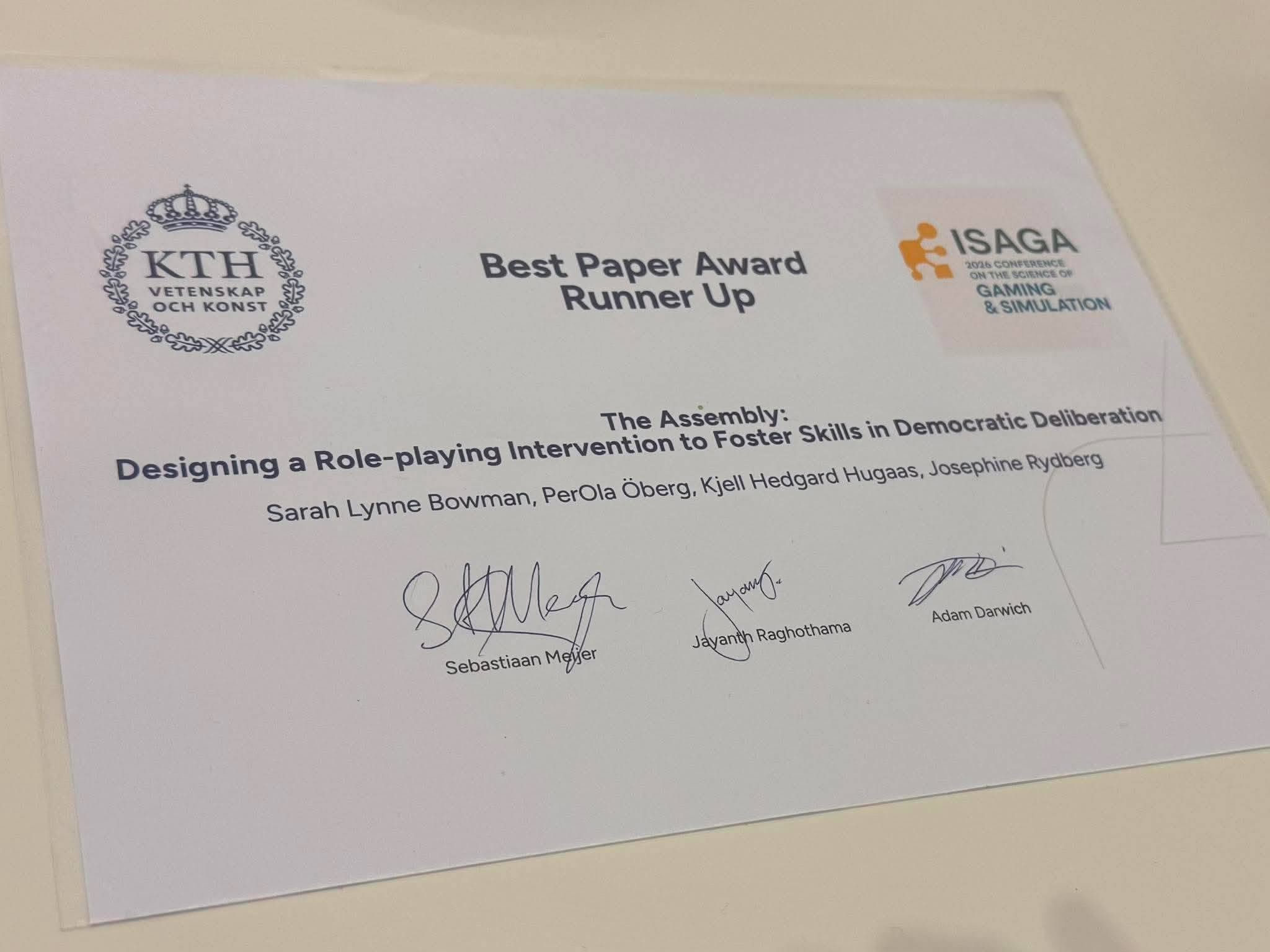
The paper was presented by Sarah Lynne Bowman and co-authored with PerOla Öberg (Uppsala University), Kjell Hedgard Hugaas (LARPifiers), and Josephine Rydberg (Stockholm University of the Arts). The award highlights the growing recognition of role-playing and simulation as rigorous methods for addressing contemporary democratic challenges.
Addressing Polarisation Through Role-Play
Across many democracies, increasing political polarisation has made respectful dialogue across differences more difficult. Public discussions often become confrontational, leaving little space for active listening, mutual understanding, or meaningful deliberation.
The Assembly responds to this challenge by exploring how live-action role-playing (larp) can help participants develop the interpersonal skills that democratic deliberation requires. Rather than persuading participants toward particular viewpoints, the experience creates structured opportunities to practise expressing perspectives clearly, listening attentively, engaging with complexity, and remaining open to reconsidering one's own assumptions.
Designed as a 3–4 hour participatory experience, The Assembly draws upon research in deliberative democracy, transformative game design, and simulation studies to create a carefully facilitated environment where diverse voices can be heard and respected.
Researching Democratic Skills
The paper focuses on the design strategies underpinning The Assembly, detailing how the intervention was developed by combining evidence from deliberative practices with methodologies from role-playing game design.
In addition to documenting the design process, the research introduces a longitudinal mixed-method assessment framework developed by the team to evaluate the experience's longer-term impact on participants. While the assessment findings will be presented in future publications, the paper establishes an important methodological foundation for studying how participatory role-play may contribute to democratic learning.
This work reflects a growing body of interdisciplinary research examining the potential of games and immersive experiences not only as educational tools, but also as spaces where civic competencies can be practised in meaningful and reflective ways.
Recognition at ISAGA 2026
Receiving the Best Paper Award – Runner-Up represents an important milestone for the research team and demonstrates the increasing interest within the international simulation and gaming community in democratic innovation through participatory design.
The award also aligns closely with the broader objectives of Larpocracy, which investigates how larp and adjacent participatory methodologies can strengthen democratic resilience, encourage inclusive dialogue, and foster meaningful civic engagement across diverse communities.
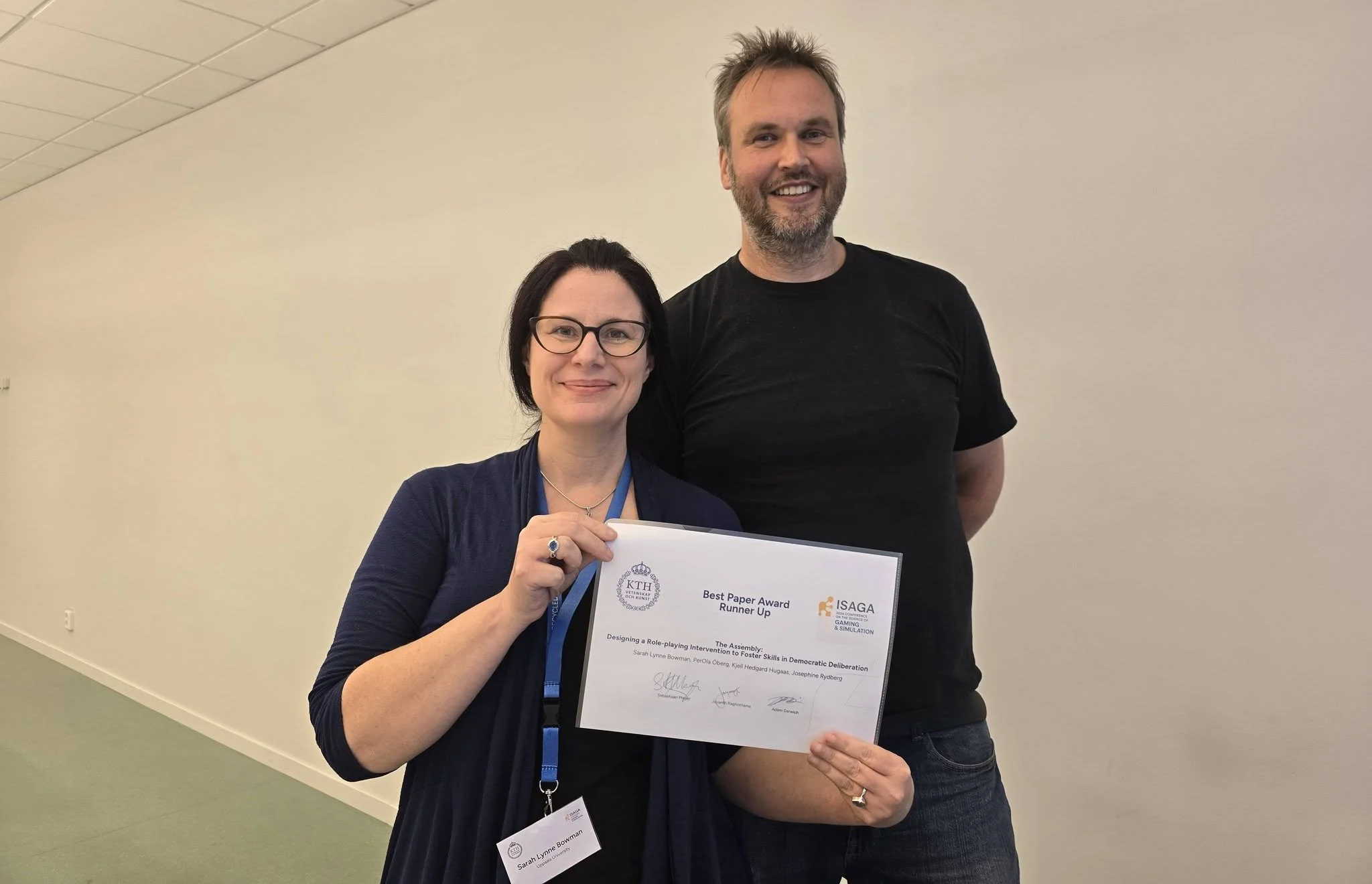
We warmly congratulate Sarah Lynne Bowman, PerOla Öberg, Kjell Hedgard Hugaas, and Josephine Rydberg on this well-deserved recognition.
We also extend our thanks to the organisers of ISAGA 2026, particularly Sebastiaan Meijer from KTH Royal Institute of Technology, pictured alongside Sarah during the award presentation.
As Larpocracy continues to explore the relationship between role-playing, participation, and democracy, achievements such as this reinforce the value of interdisciplinary collaboration and the growing impact of simulation and larp research in addressing complex societal challenges.