

Larpocracy Presents Early Research Findings at British DiGRA 2026
On 1 July 2026, Larpocracy researchers Weronika Szatkowska and Sarah Lynne Bowman from Uppsala University presented early findings from the project at British DiGRA 2026 in Wales. Their presentation explored one of the central questions driving Larpocracy: What do people actually experience and remember when participating in democracy-themed live-action role-playing games (larps)?
The paper, which also includes data analysis by Karin Johansson (Uppsala University) and Marcin Słowikowski (Europe4Youth), examines participants' descriptions of their most memorable experiences—referred to as "golden moments." By analysing these accounts, the team aims to develop a richer understanding of democracy as a lived practice rather than reducing it to formal political processes such as voting.
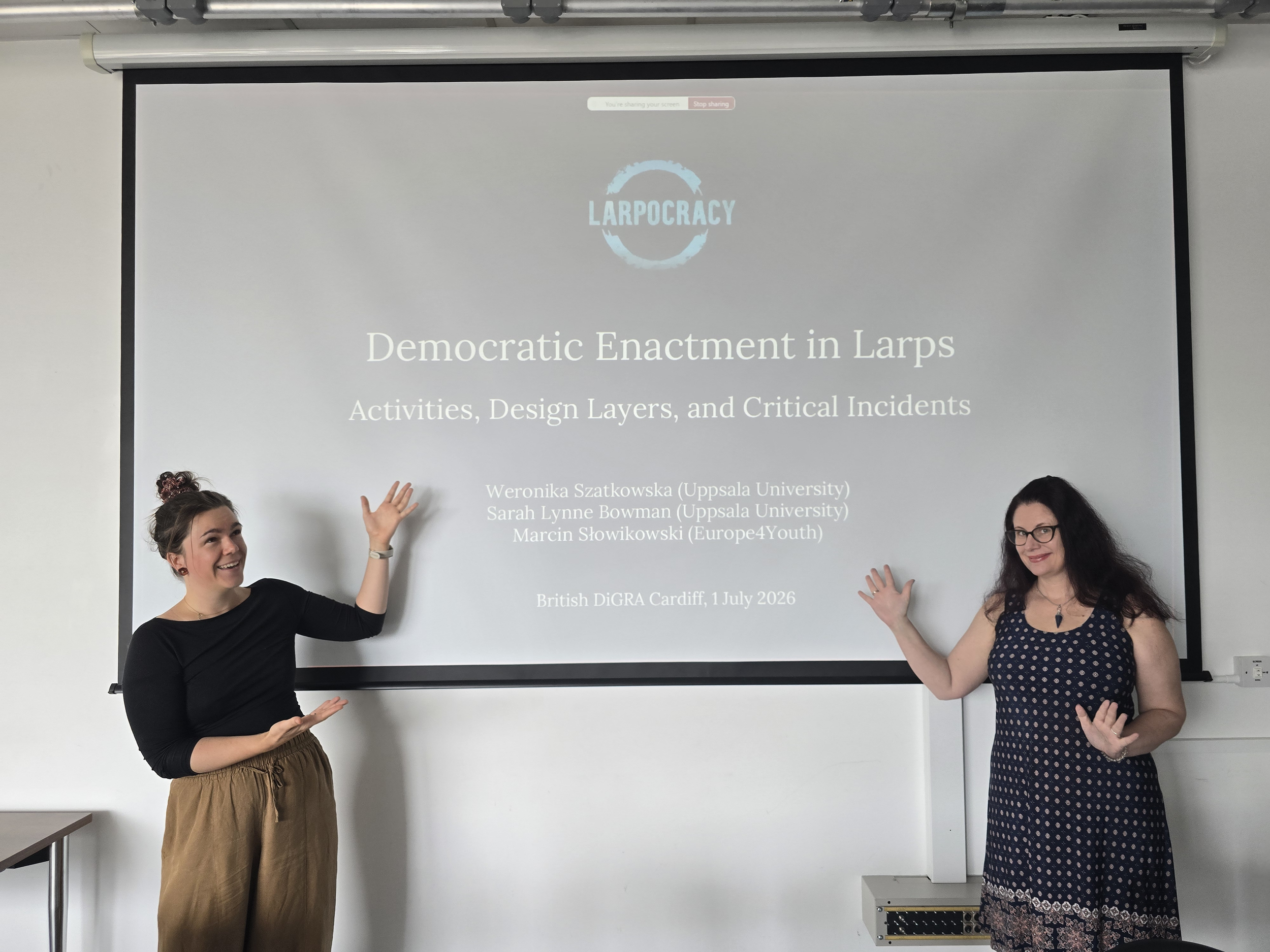
Weronika Szatkowska and Sarah Lynne Bowman at British DiGRA 2026
Democracy Beyond the Ballot Box
One of the most striking preliminary findings is the remarkable diversity of activities participants associated with meaningful democratic experiences. Rather than focusing on elections or institutions alone, players described moments centred on:
Creation and design
Organising
Collaboration
Learning
Communication
Protest and resistance
Decision-making
Experimentation and reflection
Sharing
Listening and empathy
The ongoing analysis has also identified numerous subcategories, some of which have produced unexpected insights. One particularly surprising example is making music together, highlighting how creative collaboration can become an important expression of democratic participation.
Taken together, these findings suggest that democracy is built through a wide range of collective practices that strengthen communities, encourage cooperation, and develop the interpersonal skills needed for civic life.
Building a Democracy Design Toolbox
The research also has practical implications for educators, facilitators and larp designers.
Rather than viewing democracy education solely as learning about political systems, the findings point towards designing experiences that intentionally cultivate democratic competencies. Activities such as collaborative problem-solving, active listening, shared decision-making and collective creativity can all become explicit learning objectives within democracy-focused games and simulations.
Interestingly, participants also reflected on memorable anti-democratic experiences, including situations in which they experienced oppression or found themselves acting as oppressors. These moments often generated empathy and encouraged participants to reflect on the consequences of democratic failure.
While such scenarios remain valuable educational tools, the researchers argue that future designs should increasingly focus on creating opportunities to practise prosocial democratic behaviours, even when these activities take place within dystopian or repressive fictional settings.
From Play to Civic Action
As the analysis continues, another important question has begun to emerge: Can experiences inside a larp influence behaviour outside it?
Many participants described how activities performed during the game affected their later activism, professional practice or engagement within their communities. Whether living in relatively stable democracies or in countries experiencing democratic decline, players frequently connected their in-game experiences to real-world decisions and actions.
These observations open new avenues for investigating one of the central challenges in educational research—the transfer problem. While immersive experiences can produce powerful memories and emotional engagement, understanding how these experiences become lasting behavioural change remains a key objective of the Larpocracy project.
Future research will examine how debriefing practices, embodied reflection and personal meaning-making contribute to this process, helping participants integrate their experiences into everyday civic life.
A Collaborative Research Effort
This work reflects the collaborative nature of the Larpocracy consortium. In addition to the presenting authors, the study benefited from the contributions of Barbara Mos and Piotr Warzyszyński (Europe4Youth), who supported data gathering and preparation, as well as Kjell Hedgard Hugaas (LARPifiers), whose work was instrumental in preparing the dataset for analysis.
As hundreds of participant excerpts continue to be analysed, the research team looks forward to sharing more detailed findings in the coming months.
Larpocracy is proud to contribute to the growing international conversation on how games and participatory experiences can strengthen democratic engagement—not only by helping people understand democracy, but by giving them opportunities to actively practise it.
For more information about the conference, visit: https://bdigra.co.uk/